
Complete Pickleball Court Dimensions Guide 2024
Everything you need to know about official pickleball court dimensions, measurements, and setup requirements for indoor and outdoor courts.
Official Pickleball Court Dimensions
Whether you are setting up your first pickleball court or verifying that an existing surface meets tournament standards, knowing the exact measurements is essential. The USA Pickleball Association (USAPA) and the International Federation of Pickleball (IFP) both specify identical regulation dimensions. Getting these right ensures fair gameplay and helps players develop proper positioning habits from day one.
Regulation Court Size
- Total Court Length: 44 feet (13.41 meters)
- Total Court Width: 20 feet (6.10 meters)
- Total Playing Area: 880 square feet (81.75 square meters)
- Net Height at Sidelines: 36 inches (91.44 cm)
- Net Height at Center: 34 inches (86.36 cm)
- Net Length: 22 feet (extending 1 foot past each sideline)
These dimensions are identical for both singles and doubles play, unlike tennis where the court width changes. This simplicity is one reason pickleball is so accessible to newcomers. A single court marking works for every format of the game.
Court Layout and Zones
A regulation pickleball court is divided into several distinct zones that govern where players can stand, serve, and volley. Understanding these zones is critical for learning the rules and developing effective strategy.
Non-Volley Zone (Kitchen)
The non-volley zone, commonly called the kitchen, is the most distinctive feature of a pickleball court. It extends 7 feet from the net on each side, spanning the full 20-foot width of the court.
- Width: 20 feet (same as court width)
- Depth: 7 feet from the net on each side
- Total kitchen area: 280 square feet (both sides combined)
- Players cannot volley (hit the ball out of the air) while standing in this zone
- Players may enter the kitchen to play a ball that has bounced
Service Areas
Behind each kitchen, the court is split into two equal service boxes by a centerline that runs from the kitchen line to the baseline.
- Each service area: 10 feet wide by 15 feet deep
- Four total service boxes across the court (two per side)
- Area per service box: 150 square feet
- Serves must land in the diagonal service box
Baselines and Sidelines
- Baselines: 20 feet wide (the back boundary line on each side)
- Sidelines: 44 feet long (the side boundary lines)
- Centerline: 15 feet long (divides service areas)
- All boundary lines should be 2 inches wide
- Lines are considered in bounds; a ball landing on any line is good
Space Requirements and Clearances
While the court itself measures 20 by 44 feet, you need significantly more space around it for safe and comfortable play. Players regularly run beyond the baselines and sidelines to return shots, and adequate clearance prevents injuries from collisions with walls, fences, or other courts.
Recommended Total Space
- Minimum total area: 54 feet x 30 feet (1,620 sq ft)
- Recommended total area: 64 feet x 40 feet (2,560 sq ft)
- Tournament standard: 64 feet x 40 feet with 10-foot end clearance
- End clearance: 10 feet minimum, 20 feet recommended beyond baselines
- Side clearance: 5 feet minimum, 10 feet recommended beyond sidelines
Indoor vs Outdoor Considerations
Indoor Courts
- Minimum ceiling height: 20 feet (recreational) to 24 feet (tournament)
- Less side clearance needed due to controlled environment
- Lighting requirements: 30 foot-candles minimum at court level
- Flooring: hardwood, sport tile, or cushioned surface preferred
- Consider noise dampening for multi-court facilities
Outdoor Courts
- More clearance recommended to account for wind factors
- North-south court orientation minimizes sun glare
- Consider windscreens for exposed locations
- Surface drainage: minimum 1% slope in one direction
- Fencing height: 8 to 10 feet recommended around perimeter
Court Surface and Line Materials
The playing surface affects ball bounce, player comfort, and long-term maintenance costs. Each surface type has distinct characteristics that suit different environments and budgets. For a deep dive into surface options, see our complete surface comparison guide.
Concrete
The most durable option for permanent installations. Provides consistent ball bounce when finished with an acrylic coating. Costs between $6 and $12 per square foot installed. Requires minimal maintenance but can develop cracks from ground settling over time.
Asphalt
A cost-effective alternative to concrete, typically $3 to $7 per square foot. Good durability with proper maintenance and periodic resurfacing every 4 to 8 years. Can soften in extreme heat, which changes ball bounce characteristics.
Acrylic Sport Surface
Professional-grade playing surface applied over concrete or asphalt. Offers excellent ball bounce consistency, UV stability, and customizable colors. Used in most tournament settings. Adds $3 to $6 per square foot on top of the base surface.
Line Marking Options
- Acrylic court paint: Most durable for permanent courts, lasts 3 to 5 years
- Court tape: Temporary option for shared surfaces, easy to apply and remove
- Vinyl line systems: Semi-permanent adhesive strips for multi-use facilities
- LED projection: Modern technology that projects precise regulation lines onto any flat surface with zero physical markings needed
Portable Court Solutions
Traditional court construction requires significant space, time, and investment. Depending on surface preparation and materials, building a permanent court can cost anywhere from $11,000 to $40,000 and take weeks to complete. Modern portable solutions offer a compelling alternative for players who want regulation play without permanent infrastructure.
Why Choose a Portable Court System?
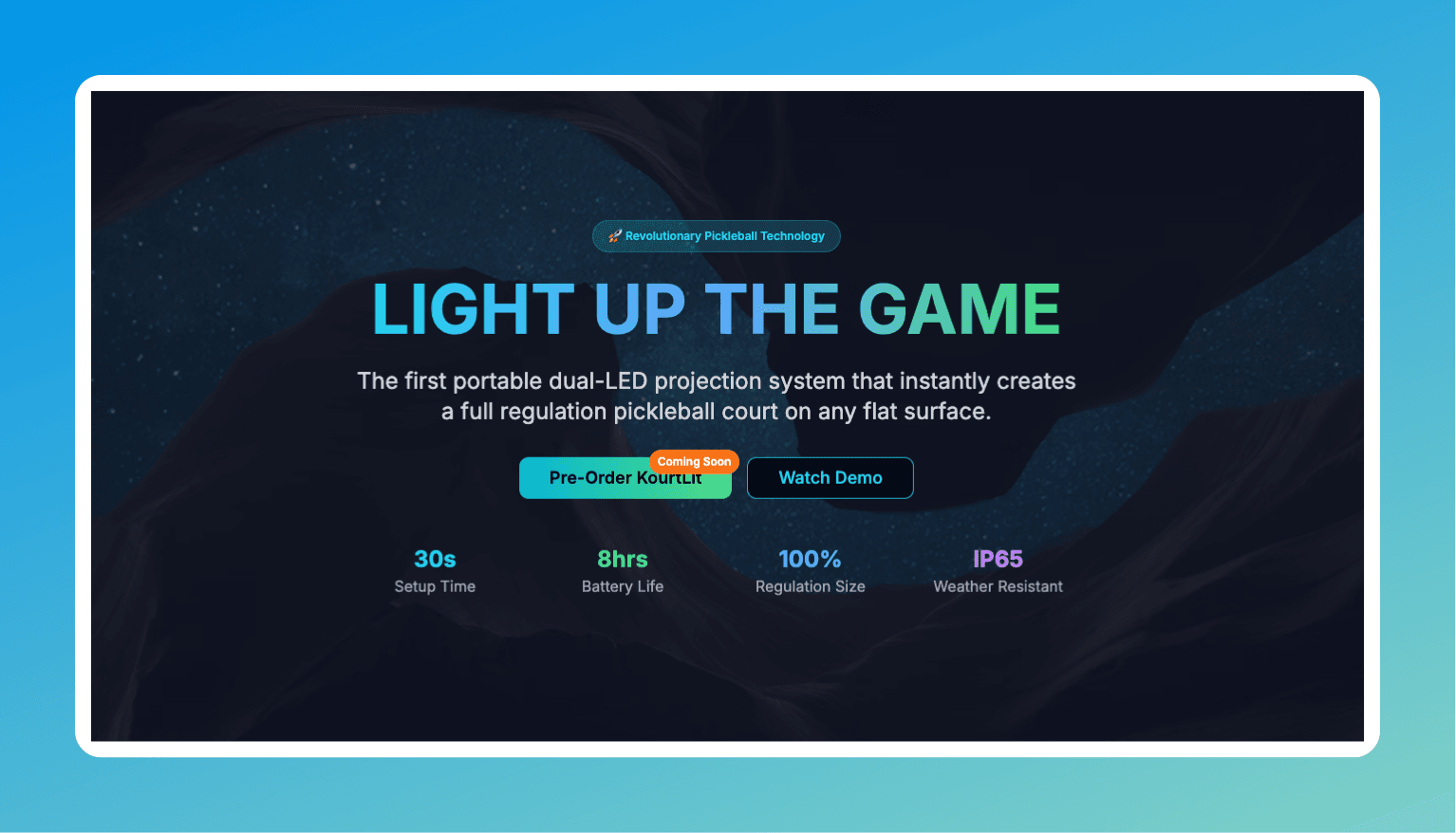
The KourtLit projection system uses dual LED projectors to cast precise regulation court lines onto any flat surface in under 30 seconds. This eliminates the need for permanent construction while maintaining official dimensions down to the inch.
- Perfect regulation dimensions every time with no measuring or taping
- No permanent space commitment required
- Set up on driveways, parking lots, gym floors, or any flat surface
- Cost-effective at $2,999 compared to $15,000+ for permanent construction
- IP65 weather resistance for reliable outdoor use
- 8+ hour battery life covers a full day of play
For a detailed cost and performance comparison between portable projection systems and traditional built courts, read our KourtLit vs Permanent Courts analysis. If you are considering building your own, our DIY vs Professional Courts guide breaks down what to expect in terms of cost, quality, and effort.
Expert Setup Tips
Pro Tips for Court Setup
- Measure twice: Always verify dimensions from multiple reference points before marking permanent lines. Use a steel tape measure rather than a cloth one for accuracy.
- Check surface level: Use a long level or laser level to confirm the surface is flat. Even small dips can affect ball bounce and drainage.
- Orient correctly: For outdoor courts, align the long axis north-south so neither player faces directly into the sun during morning or afternoon play.
- Test the net height: Verify 36 inches at the sideline posts and 34 inches at center. A sagging net changes the entire dynamic of the game.
- Consider neighbors: Pickleball generates significant noise. Position courts away from bedroom windows, and consider using quieter paddle types and noise barriers if you have close neighbors.